

Airline Weather
Industry Solutions
Explore real-world use cases and solutions tailored to each industry's unique weather challenges.


Construction Weather

Logistics Weather

Facility & Plant Weather

Municipal Weather

Retail Weather

Energy Weather

Dam Weather

Insurance Weather

Agricultural Weather

School Weather

Event Weather

Sports Weather

Road Weather

Railway Weather

Climate Tech

Broadcasting Weather

Coastal Weather

Airline Weather

General Aviation Weather

Drone Weather
Weather Solutions
Industry Solutions
Top PageWeather Solutions
Analysis of Aviation Meteorological Elements at Kaohsiung International Airport (RCKH/KHH)
April 16, 2026 Weathernews

Kaohsiung International Airport (RCKH/KHH) serves as the ”Southern Gateway” of Taiwan, supporting the industry and tourism of Kaohsiung City in southern Taiwan. As Taiwan's second-largest international airport after Taoyuan International Airport (RCTP/TPE), it plays a central role in connecting the southern region with destinations around the world.
This analysis is based on five years of observational data (METAR) from 2020 to 2024, summarizing the key trends and characteristics of aviation meteorological elements at RCKH. It is intended to support more accurate operational decision-making and proactive management of weather-related risks.
Kaohsiung International Airport is located in Xiaogang District, Kaohsiung City, in southern Taiwan. Situated at a low elevation of approximately 10m (32ft) and in close proximity to the Taiwan Strait, the airport is subject to the direct influence of maritime air masses. Under the Köppen climate classification, it falls within the tropical savanna climate zone, characterized by warm temperatures throughout the year. The airport operates a single asphalt runway, RWY 09/27 (3,150×60m), oriented in an east-west direction.
Wind Direction
・Westerly winds (260–280°) are the prevailing wind direction throughout the year, with northerly winds (350–360°) also frequently observed. ・A clear seasonal shift is evident: westerly to west-southwesterly winds (250–280°) dominate from March to November, while northerly winds (350–360°) prevail from December to February. ・During June to August, northeasterly to east-northeasterly winds (40–80°) also tend to be prevalent. ・Crosswind conditions occur more frequently from December to February.
Wind Speed
・Strong winds of 13KT or above are relatively uncommon throughout the year. ・Gust activity tends to increase slightly from July to October, likely associated with convective activity (CB) and typhoons.
Precipitation
・Rainfall is observed throughout the year, with the highest frequency typically occurring in July. ・Due to consistently high temperatures, snowfall is not observed.
Thunderstorm
・Thunderstorm activity is observed throughout the year, with the highest frequency typically occurring in August. ・While thunderstorms can occur at any time of day, they tend to be slightly more frequent in the local afternoon hours, a pattern that becomes particularly pronounced from July to September. ・Contributing factors include both air mass thunderstorms driven by surface heating, as well as frontal thunderstorms associated with the passage of weather fronts.
Visibility (VIS)
・Significant low visibility below 800m is relatively rare, with observed peaks typically occurring in the early morning and during daytime hours. ・June sees the highest frequency of low visibility events, primarily attributed to reduced visibility caused by heavy rainfall. ・Low visibility conditions are observed across most hours of the day, with the exception of 05Z, 16Z, and 19Z.
Ceiling (CIG)
・Ceiling conditions below 200ft are extremely rare.
Temperature
・Average temperatures tend to exceed 30°C during daytime hours (01–08Z) from June to September. ・In May and October, average temperatures may also exceed 30°C during certain daytime hours. High temperatures lead to an increase in density altitude, which can affect aircraft takeoff and landing performance. Extra caution is advised during these periods.
Explore real-world use cases and solutions tailored to each industry's unique weather challenges.
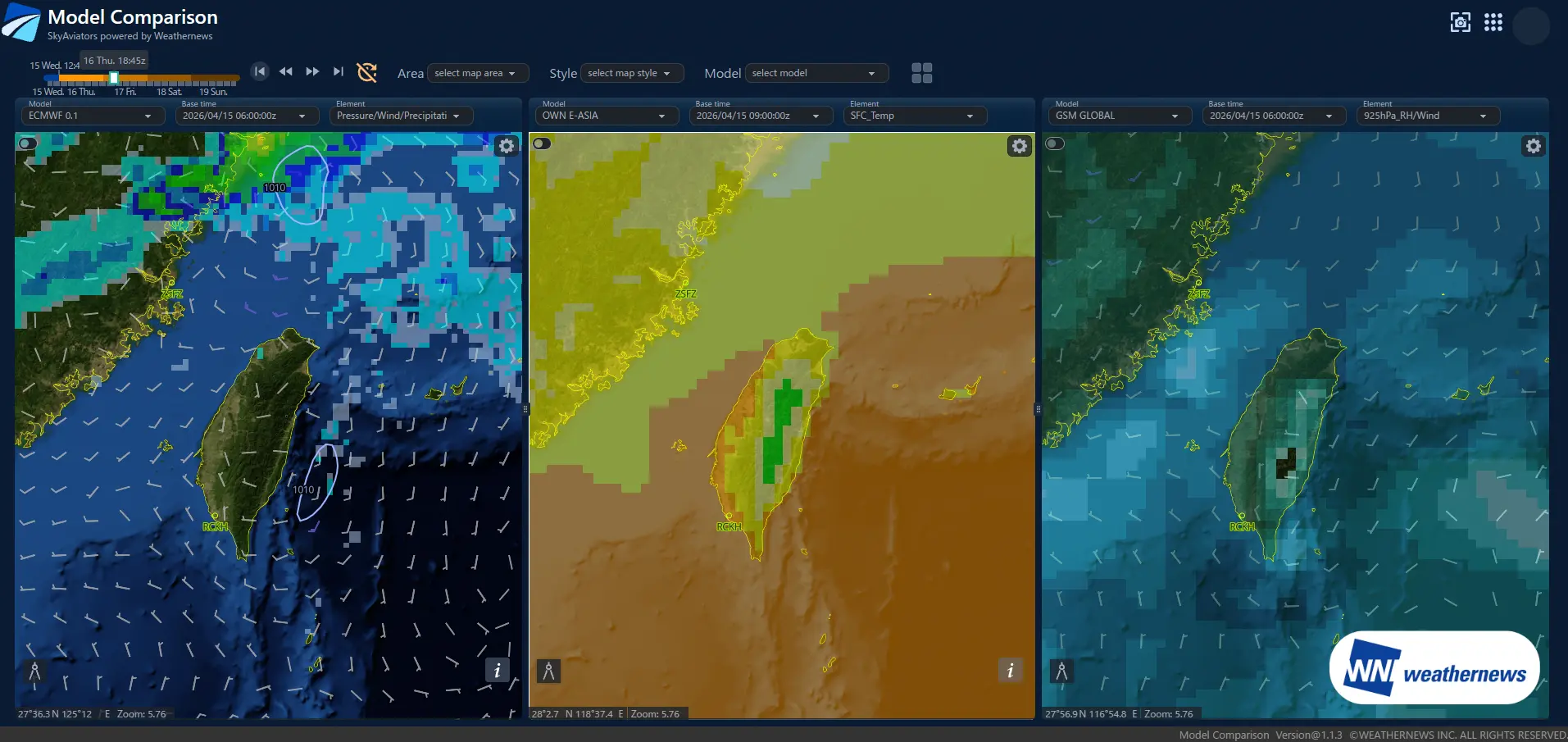
SkyAviators is a comprehensive weather intelligence platform developed by Weathernews for airlines. Powered by world-class meteorological data and decades of aviation weather expertise, it empowers operational decision-making when it matters most. The Airport Summary & Model Comparison feature integrates multiple numerical weather prediction models and ICAO-standard forecast reliability assessments into a single view. This enables users to quickly identify forecast discrepancies and uncertainty, supporting weather interpretation and decision-making aligned with airline operational policies.
Multiple numerical weather prediction models—including regional models, global models, and proprietary forecasts—are consolidated into a single view together with historical observation data.
Forecast reliability for each numerical model is visualized using evaluation methods based on ICAO standards.
Three numerical weather prediction models for the same region are displayed in parallel, enabling direct comparison under identical conditions.
Historical observations, current conditions, and future forecasts are seamlessly integrated into a time-series display.
Objective reliability assessments clarify which model should be used as the decision reference. This improves both the speed and confidence of Go / No-Go decisions, helping prevent delays in operational judgment.
Model reliability is standardized using ICAO-based evaluation methods, reducing reliance on individual expertise or personal judgment. This allows the entire team to apply consistent decision criteria.
When weather variability is high and decisions become challenging, multiple forecast models are compared and their confidence evaluated to provide reliable support for operational decision-making.
There is no need to switch between multiple websites or screens. By consolidating all relevant information into a single view, analysis time is reduced, allowing teams to focus on making decisions.
Please feel free to consult with us about implementation methods, features, or advancing specific considerations. We'll answer even the smallest questions.
We'll explain pricing details and provide specific content based on your site conditions so you can consider with confidence.
Free Quote
We'll explain in detail how to utilize features and the implementation process. Please feel free to consult with us.
Consider Implementation