

Airline Weather
Industry Solutions
Explore real-world use cases and solutions tailored to each industry's unique weather challenges.


Construction Weather

Logistics Weather

Facility & Plant Weather

Municipal Weather

Retail Weather

Energy Weather

Dam Weather

Insurance Weather

Agricultural Weather

School Weather

Event Weather

Sports Weather

Road Weather

Railway Weather

Climate Tech

Broadcasting Weather

Coastal Weather

Airline Weather

General Aviation Weather

Drone Weather
Weather Solutions
Industry Solutions
Top PageWeather Solutions
Warm Air Surges into Spain, Bringing Record Heat — Madrid-Barajas Airport (LEMD/MAD) Temperature Trend Analysis
April 22, 2026 Weathernews

A surge of warm air is moving over Spain, with unseasonably high temperatures expected to persist from April 18 to 23. The Spanish State Meteorological Agency (AEMET) has indicated that, during this period, temperatures in various parts of the country may exceed the April records based on the 1991–2020 climatological baseline. These levels are expected to be comparable to the heat observed in April 2023.
Table of Contents [ ]
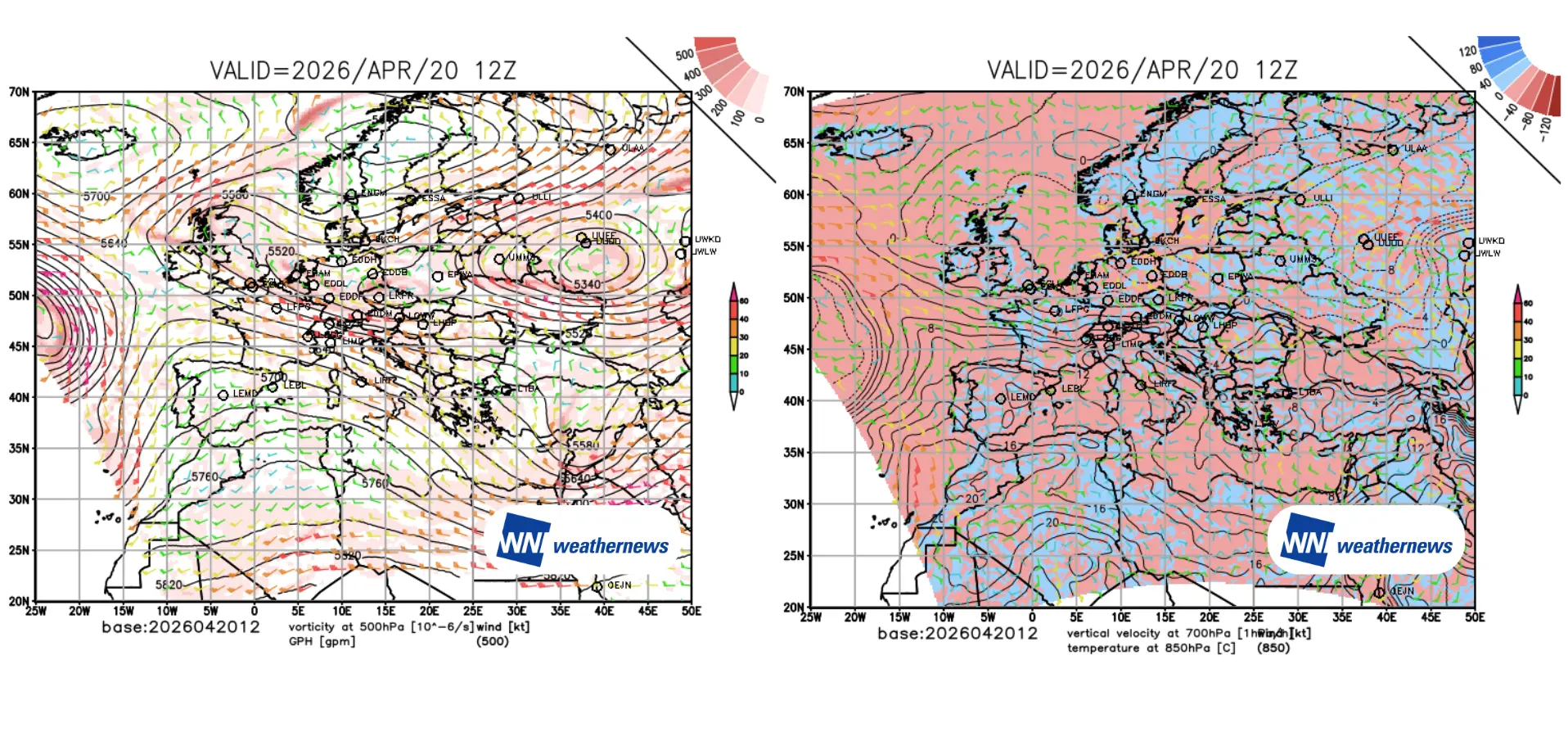
Around 15Z on April 23, the Iberian Peninsula is expected to remain under the influence of a 500 hPa ridge, particularly over its eastern parts. At the surface, the region is likely to be on the rear side of a high-pressure system centered over the Mediterranean. At 850 hPa, warm air with temperatures of 18°C or higher is forecast to cover much of Spain, especially inland areas. Combined with solar heating, this will create conditions favorable for further rises in near-surface temperatures.(The figure below shows WNI's OWN model.)
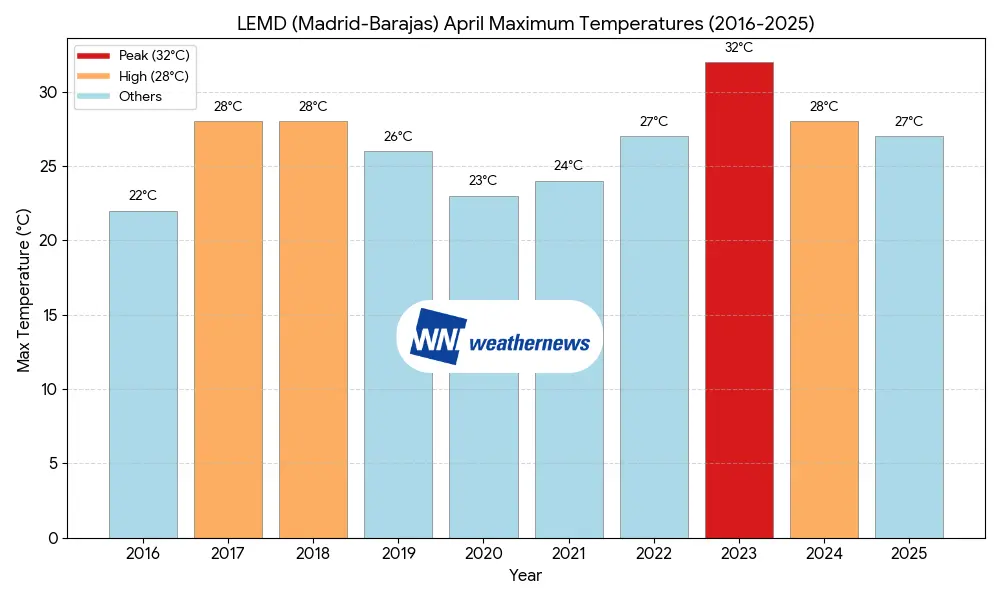
At Madrid-Barajas Airport (LEMD/MAD), the average of the April maximum temperatures over the 10-year period from 2016 to 2025 was 26.5°C. The highest value was 32°C in 2023, followed by 28°C in 2017, 2018, and 2024, and 27°C in 2022 and 2025. A warming tendency is evident within this period, with higher maximum temperatures observed in the most recent five years. The average was 25.4°C for 2016–2020, compared to 27.6°C for 2021–2025, representing a difference of more than 2°C.
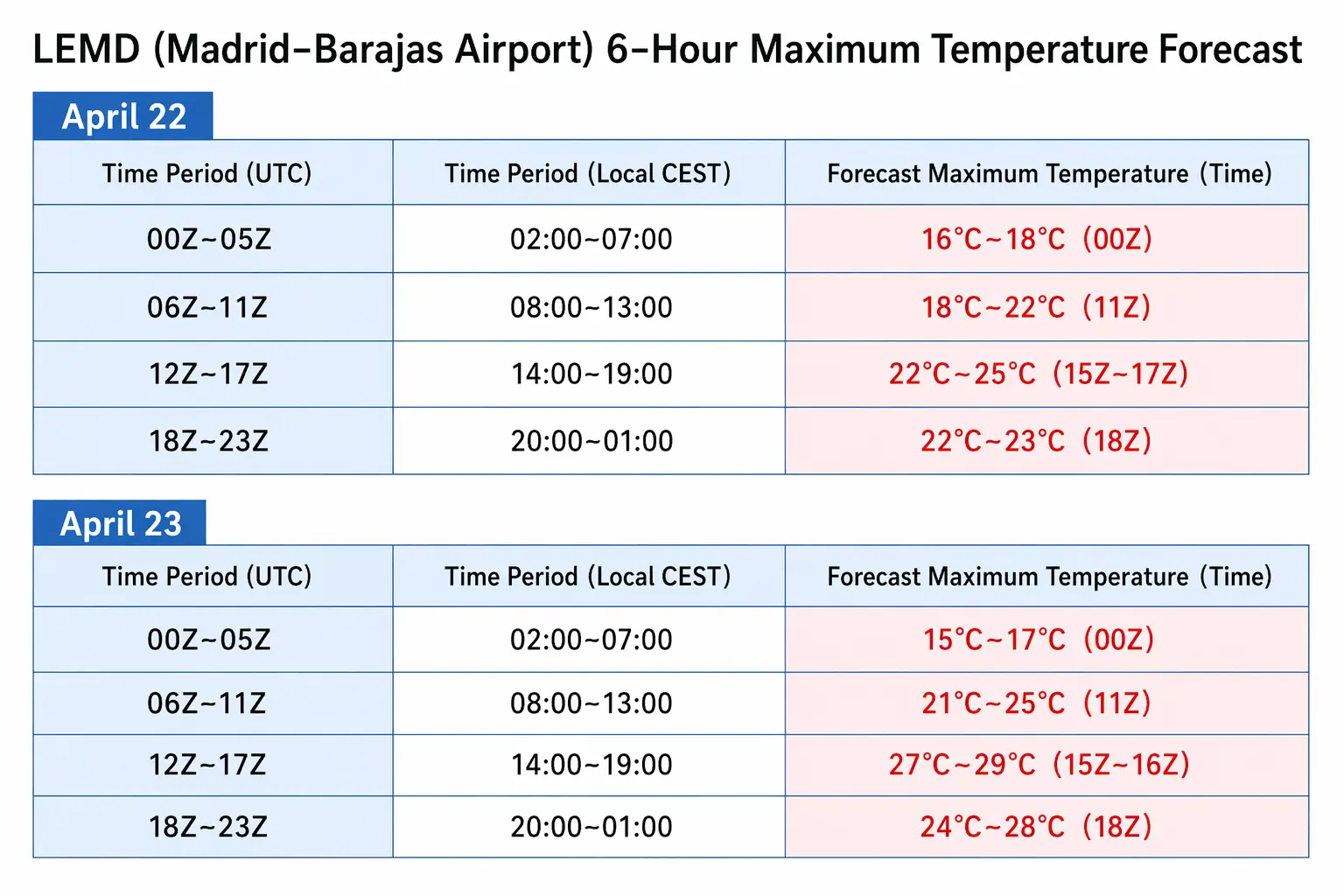
At Madrid-Barajas Airport (LEMD/MAD), the maximum temperature on Monday, April 18 has already reached 28°C, matching the highest April values recorded in 2017, 2018, and 2024. Temperatures are expected to continue rising, with a chance of exceeding 28°C around April 23. However, it is considered unlikely to surpass the April 2023 record of 32°C, the highest value in the past decade.
Relationship between temperature and Maximum Take-off Weight (MTOW) In general, as ambient temperature increases, air density decreases and take-off thrust becomes weaker. As a result, the allowable take-off weight is reduced. Therefore, lower temperatures provide greater margin for take-off. On the other hand, when the ambient temperature exceeds 30℃, and the rate of decrease accelerates sharply at approximately 36℃ and above. For aircraft types and routes that normally operate close to MTOW, temperature rise is already a significant operational constraint. Under abnormally high temperature conditions, the impact is likely to extend to a wider range of aircraft types and routes.
Explore real-world use cases and solutions tailored to each industry's unique weather challenges.
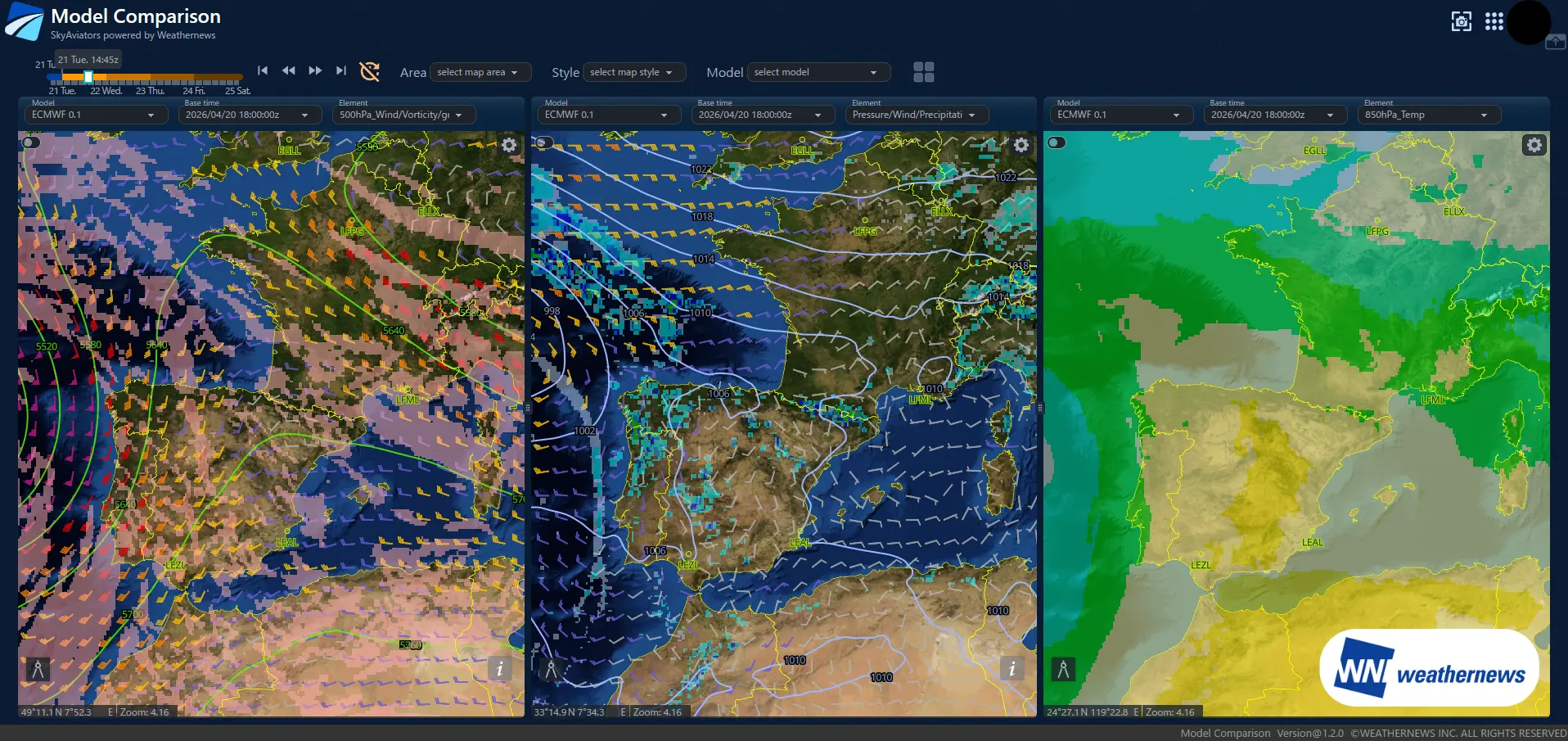
SkyAviators is a comprehensive weather intelligence platform developed by Weathernews for airlines. Powered by world-class meteorological data and decades of aviation weather expertise, it empowers operational decision-making when it matters most. The Airport Summary & Model Comparison feature integrates multiple numerical weather prediction models and ICAO-standard forecast reliability assessments into a single view. This enables users to quickly identify forecast discrepancies and uncertainty, supporting weather interpretation and decision-making aligned with airline operational policies.
Multiple numerical weather prediction models—including regional models, global models, and proprietary forecasts—are consolidated into a single view together with historical observation data.
Forecast reliability for each numerical model is visualized using evaluation methods based on ICAO standards.
Three numerical weather prediction models for the same region are displayed in parallel, enabling direct comparison under identical conditions.
Historical observations, current conditions, and future forecasts are seamlessly integrated into a time-series display.
Objective reliability assessments clarify which model should be used as the decision reference. This improves both the speed and confidence of Go / No-Go decisions, helping prevent delays in operational judgment.
Model reliability is standardized using ICAO-based evaluation methods, reducing reliance on individual expertise or personal judgment. This allows the entire team to apply consistent decision criteria.
When weather variability is high and decisions become challenging, multiple forecast models are compared and their confidence evaluated to provide reliable support for operational decision-making.
There is no need to switch between multiple websites or screens. By consolidating all relevant information into a single view, analysis time is reduced, allowing teams to focus on making decisions.
Please feel free to consult with us about implementation methods, features, or advancing specific considerations. We'll answer even the smallest questions.
We'll explain pricing details and provide specific content based on your site conditions so you can consider with confidence.
Free Quote
We'll explain in detail how to utilize features and the implementation process. Please feel free to consult with us.
Consider Implementation