

Airline Weather
Industry Solutions
Explore real-world use cases and solutions tailored to each industry's unique weather challenges.


Construction Weather

Logistics Weather

Facility & Plant Weather

Municipal Weather

Retail Weather

Energy Weather

Dam Weather

Insurance Weather

Agricultural Weather

School Weather

Event Weather

Sports Weather

Road Weather

Railway Weather

Climate Tech

Broadcasting Weather

Coastal Weather

Airline Weather

General Aviation Weather

Drone Weather
Weather Solutions
Industry Solutions
Top PageWeather Solutions
Incheon International Airport (RKSI/ICN) — Seasonal Meteorological Characteristics and Operational Impacts
April 27, 2026 Weathernews
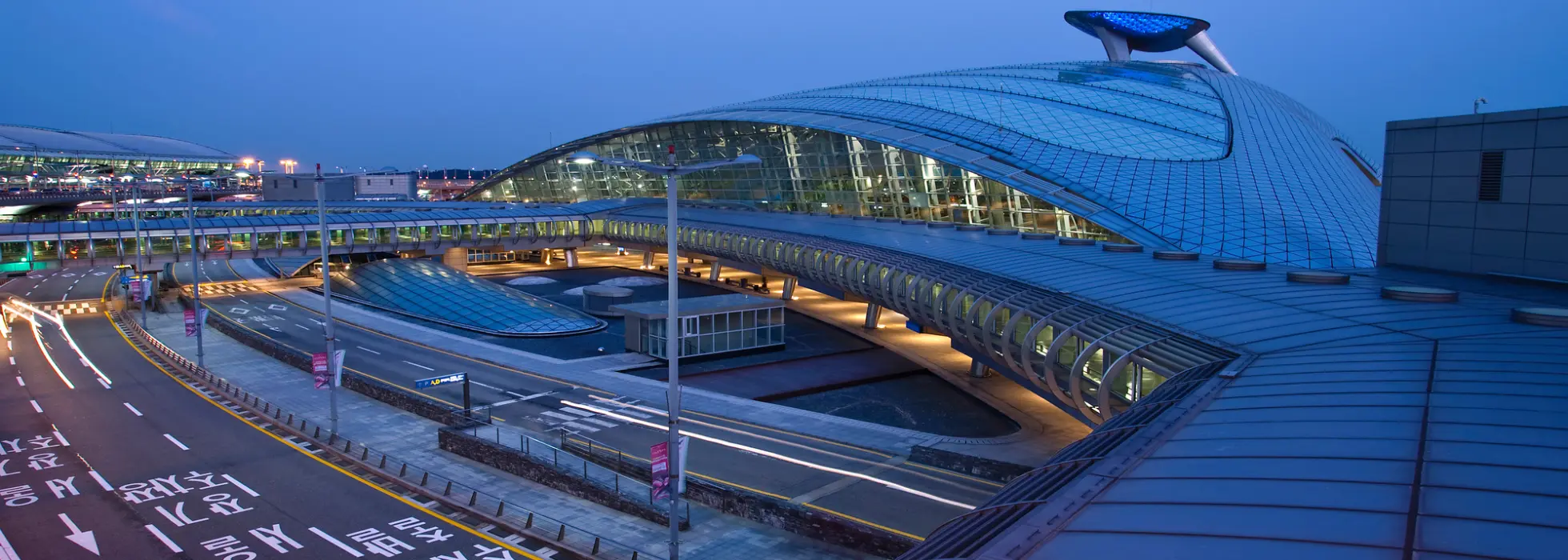
Incheon International Airport in South Korea (RKSI/ICN) lies in a temperate climate zone with clearly defined seasons, and different meteorological risks affect operations throughout the year. Strong northwesterly winds and snowfall in winter, sea fog from spring to summer, and thunderstorms in summer are among the seasonal weather characteristics. Understanding these seasonal weather patterns is essential for developing stable flight operation plans.
Incheon International Airport (RKSI) is an international airport located on Yeongjong Island, west of Seoul, South Korea. The airport island is surrounded by the sea, and the large tidal range influences its local weather characteristics. The region has clearly defined seasons: strong northwesterly winds associated with the winter monsoon in winter; sea fog from spring through summer; thunderstorms in summer; and visibility restrictions caused by radiational cooling as well as snowfall from autumn into winter. These seasonal weather phenomena can affect flight operations in different ways throughout the year.
In early spring, strong northwesterly winds associated with the winter pressure pattern can still occur, but they gradually decrease while strong southwesterly winds ahead of passing cold fronts become more frequent. On average, winds exceeding 20 knots occur about once every few days, and attention should also be paid to crosswind components. In addition, sea fog becomes more likely to develop from April onward. In many cases, visibility recovers to more than 1,000 m by around 23–01Z, although it can occasionally persist longer.
This is the peak season for sea fog. In July, visibility falls below 1,000 m about once every three days. The fog often advects into the area with southwesterly or south-southeasterly winds, and a rapid drop in visibility and ceiling after the evening hours requires particular attention. When dense fog covers a wide area, it may persist until around midday, and in some cases can last throughout the day. Frontal fog associated with the monsoon front also needs to be monitored. Thunderstorms also become frequent in July and August, with lightning observed on roughly one day each week. These events are often associated either with the monsoon front or with cold air aloft interacting with warm southerly winds in the lower atmosphere.
The occurrence of sea fog and thunderstorms gradually decreases, but by around November, visibility restrictions caused by radiational cooling can occur during the early morning and evening hours. Although Incheon Airport is located on an island, the surrounding sea has a large tidal range, and at low tide, radiational fog may advect in from the Seoul area during the night or early morning with easterly winds. By November, northwesterly winds become dominant, and mean wind speeds exceed 20 kt about once every few days.
The occurrence of sea fog and thunderstorms becomes less frequent. However, around November, visibility restrictions caused by radiational cooling can occur in the early morning and evening hours. Although Incheon Airport is located on an island, the surrounding sea has a large tidal range, and at low tide, radiational fog may advect in from the Seoul area during the night or early morning with easterly winds. By November, northwesterly winds become dominant, and mean wind speeds exceed 20 kt about once every few days.
Explore real-world use cases and solutions tailored to each industry's unique weather challenges.
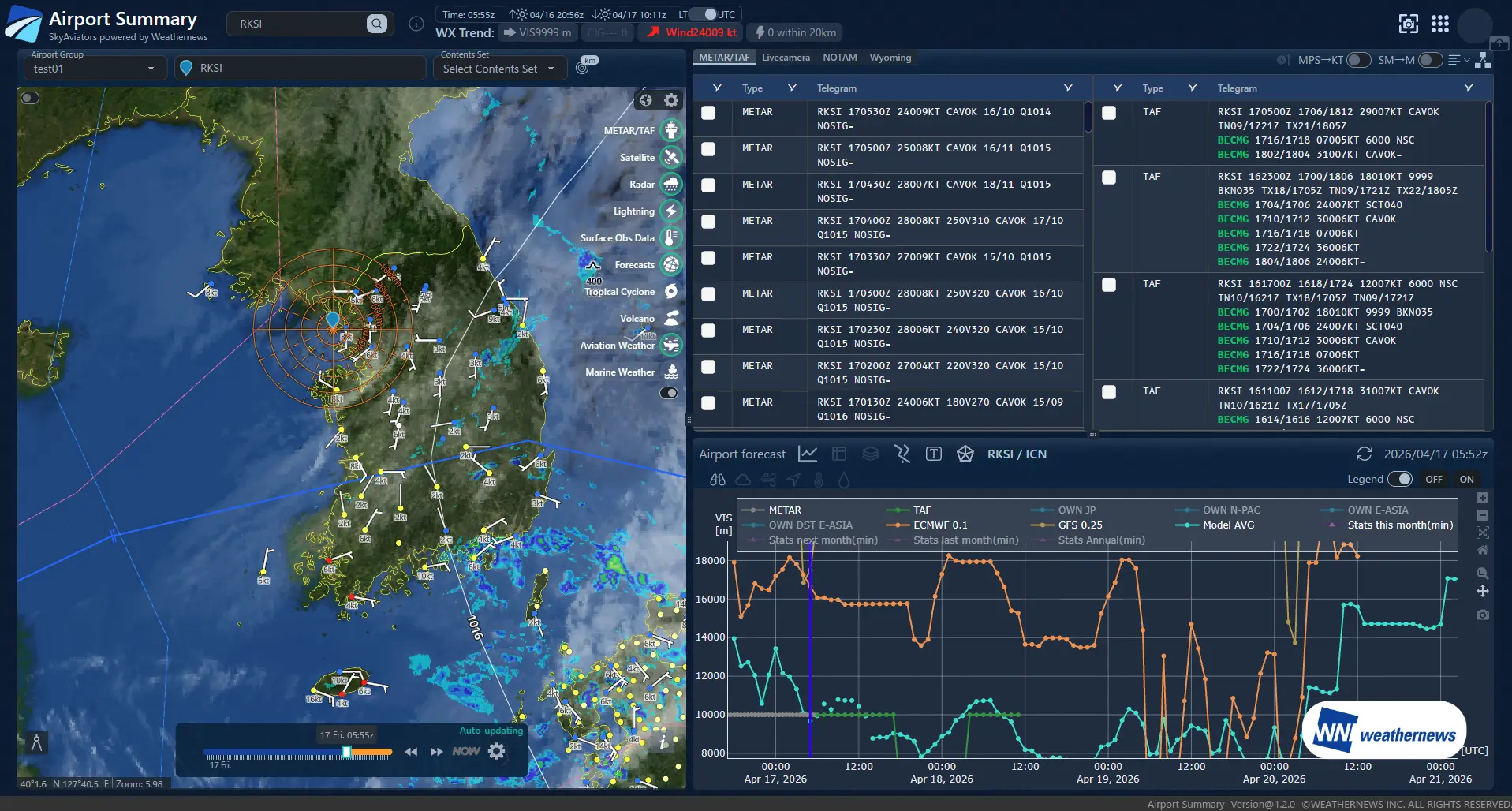
SkyAviators is a comprehensive weather intelligence platform developed by Weathernews for airlines. Powered by world-class meteorological data and decades of aviation weather expertise, it empowers operational decision-making when it matters most. The Airport Summary & Model Comparison feature integrates multiple numerical weather prediction models and ICAO-standard forecast reliability assessments into a single view. This enables users to quickly identify forecast discrepancies and uncertainty, supporting weather interpretation and decision-making aligned with airline operational policies.
Multiple numerical weather prediction models—including regional models, global models, and proprietary forecasts—are consolidated into a single view together with historical observation data.
Forecast reliability for each numerical model is visualized using evaluation methods based on ICAO standards.
Three numerical weather prediction models for the same region are displayed in parallel, enabling direct comparison under identical conditions.
Historical observations, current conditions, and future forecasts are seamlessly integrated into a time-series display.
Objective reliability assessments clarify which model should be used as the decision reference. This improves both the speed and confidence of Go / No-Go decisions, helping prevent delays in operational judgment.
Model reliability is standardized using ICAO-based evaluation methods, reducing reliance on individual expertise or personal judgment. This allows the entire team to apply consistent decision criteria.
When weather variability is high and decisions become challenging, multiple forecast models are compared and their confidence evaluated to provide reliable support for operational decision-making.
There is no need to switch between multiple websites or screens. By consolidating all relevant information into a single view, analysis time is reduced, allowing teams to focus on making decisions.
Please feel free to consult with us about implementation methods, features, or advancing specific considerations. We'll answer even the smallest questions.
We'll explain pricing details and provide specific content based on your site conditions so you can consider with confidence.
Free Quote
We'll explain in detail how to utilize features and the implementation process. Please feel free to consult with us.
Consider Implementation