










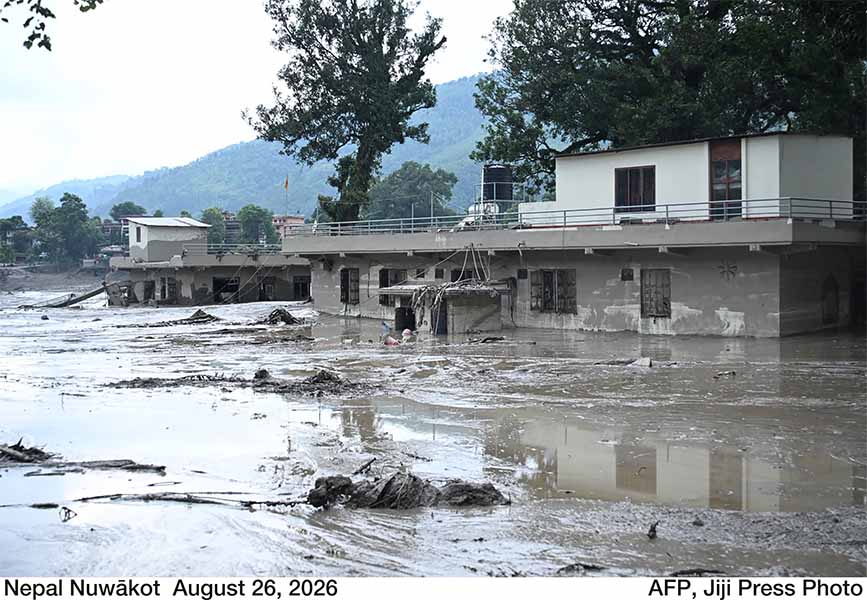
In Nepal, a major flash flood struck the Bhote Koshi River in Rasuwa District on Wednesday the 26th (local time), leaving many dead or missing. Nepal's Department of Hydrology and Meteorology continues to warn of the risk of flooding and landslides.
Possible Glacial Lake Outburst: Debris Flow From the Tibet Border
The disaster is believed to have been triggered by a debris flow and a glacial lake outburst flood (ice-jam outburst, GLOF) that occurred near the border with the Tibet Autonomous Region.
Some had suspected an earthquake was the cause of the collapse, but the USGS (United States Geological Survey) conducted additional analysis of the seismic activity observed on the morning of Wednesday the 26th (local time), using data from nearby seismic stations, long-period seismic waves, and satellite imagery, and concluded that the tremor was not caused by an earthquake but by a glacier collapse and debris flow.
The damage was not limited to Nepal; a debris flow also occurred simultaneously in Shigatse, in China's Tibet Autonomous Region, with multiple deaths and missing persons reported there as well. In the Himalayan region, the expansion of glacial lakes and the associated risk of outburst flooding due to climate change have long been pointed out.
Foreign Tourists Also Affected
More than a day after the disaster struck, the full extent of the damage is still not known. Reported death tolls vary by media outlet from 95 to more than 160, while the number of missing has grown to a range of about 400 to more than 750.
The missing include more than 100 Indian nationals and numerous other foreign tourists from South Korea, Canada, New Zealand and elsewhere. Contact has also been lost with 5 Japanese nationals believed to have been in the area on a tour, and the Japanese Embassy in Nepal has requested that Nepali authorities carry out a search and rescue operation.
More than 19 bridges, about 40km of roads, and more than a dozen hydroelectric power plants have been damaged or swept away, and communication and power networks have been cut off over a wide area.
Search Operations Continue; Vigilance Needed Against Secondary Landslide Disasters
Search operations by the Nepali police and military are continuing, but some areas remain difficult to reach because of damaged road networks. The region is still under the influence of the monsoon, and vigilance is also needed against secondary disasters such as landslides in areas where the ground has become loosened.
Nepal's Department of Hydrology and Meteorology continues to monitor river water levels through its flood early warning service and is calling on residents in the affected areas to remain on maximum alert.