










Overview
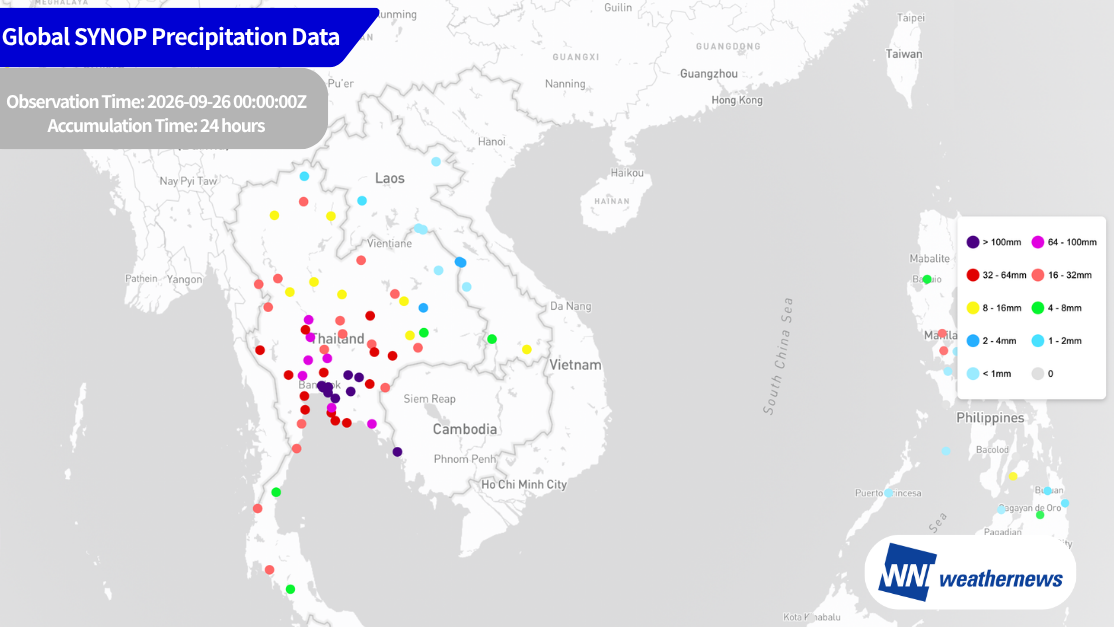
Heavy rain across central Thailand has caused widespread flooding in Bangkok and the surrounding area. The rain was driven by a deep low-pressure system that developed along the Intertropical Convergence Zone (ITCZ), with circulation extending from the lower to the upper troposphere. Suvarnabhumi International Airport (VTBS/BKK) and Don Mueang International Airport (VTBD/DMK) remain operational, but flooded access roads and a shortage of ground-handling staff have led to flight and baggage delays. The low has already moved west of Bangkok, and the heaviest rain appears to have passed. However, colder air aloft is keeping the atmosphere unstable, leaving the city vulnerable to thunderstorms with rain (TSRA).
Flooding across Thailand
According to Report No. 542 for Buddhist Era 2569, issued by Thailand's Department of Disaster Prevention and Mitigation (DDPM) at 6 p.m. local time on September 28, 2026, heavy rain and related weather between September 16 and 28 caused extensive flooding. So far, approximately 927,000 households and 2.56 million people have been affected across 41 provinces and Bangkok, and 23 people have died.
The floods reached 214 districts, 1,017 subdistricts and 5,164 villages. Twenty-three deaths have been confirmed; no injuries have been reported.
As of 6 p.m. on September 28, flooding was still ongoing in 28 provinces and Bangkok. Inundation and other impacts remained in 160 districts, 849 subdistricts and 4,685 villages, affecting approximately 921,000 households and 2.55 million people.
Flooding in Bangkok
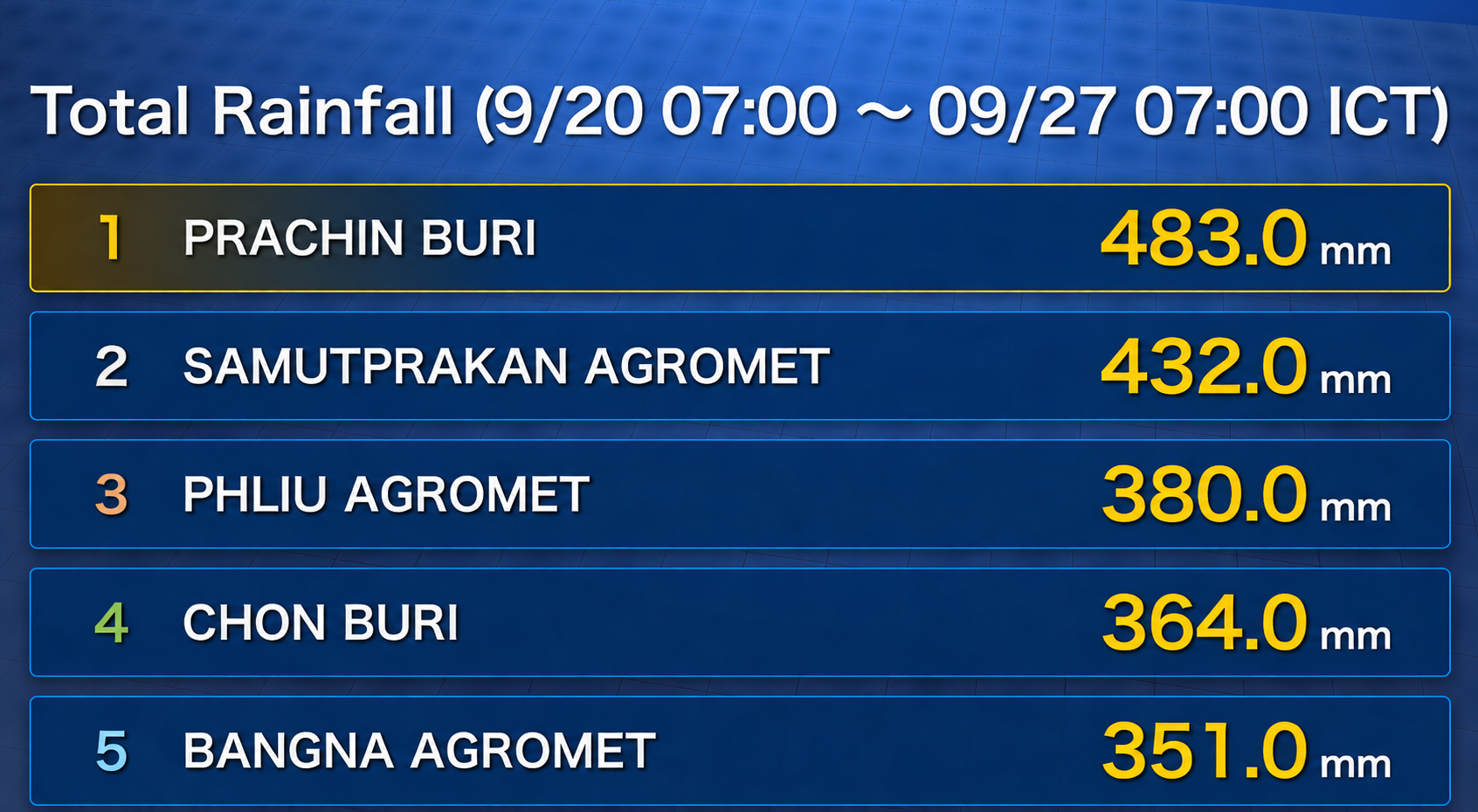
Flooding has affected all 50 of Bangkok's districts. Rain fell almost continuously for about three days, from the afternoon of September 24 to the afternoon of September 27. Major canals filled to capacity, and flooded roads—particularly in central and eastern Bangkok—brought traffic to a standstill. According to a September 28 announcement by the Bangkok Metropolitan Administration, approximately 329,000 households, or about 700,000 people, have been affected. Lat Krabang, Bang Kapi and Khan Na Yao are among the hardest-hit districts. Work continues to lower water levels in major canals and drain roads and residential areas.
Source: PR Thai Government, “Bangkok Flood Update 28 Sept: Rain Easing, 700K Affected” (September 28, 2026)
Meteorological factors: A deep low developed along the ITCZ
A low-pressure system developed along an east-west-oriented shear line associated with the Intertropical Convergence Zone (ITCZ) and remained nearly stationary over the Bangkok area. The system had a deep vertical structure, extending from the lower to the upper troposphere.
Warm, moist air flowed into the system, creating an unstable atmospheric environment favorable for the development of deep convective clouds. These conditions supported the repeated formation and passage of active thunderstorms, bringing widespread heavy rainfall, particularly across central and eastern Thailand.
Impact on aviation
Air transport operations continue at Suvarnabhumi Airport (VTBS/BKK) and Don Mueang Airport (VTBD/DMK). Although some flights have been delayed, neither airport has reported large-scale passenger backlogs.
At Suvarnabhumi, the main access roads remain passable, but flooding is severe on routes via Lat Krabang. The Airport Rail Link between the airport and the city continues to operate. Some ground-handling staff have been unable to get to work, leaving the airport short-staffed and contributing to flight and baggage delays.
At Don Mueang, water flowed onto part of the southern taxiway after heavy rain that lasted throughout the day. Thailand's Ministry of Transport says, however, that the flooding has not affected overall airport operations and that aircraft are taking off and landing as usual.
The Civil Aviation Authority of Thailand (CAAT) is advising passengers using either airport to allow extra travel time, check flight status directly with their airlines and keep up with the latest information while the weather remains unsettled.
Airlines are also offering assistance to passengers unable to travel as planned because of flooding and traffic disruption. Depending on each airline's rules and conditions, passengers may be able to change their itineraries or retain the value of unused tickets as travel credit for later use.
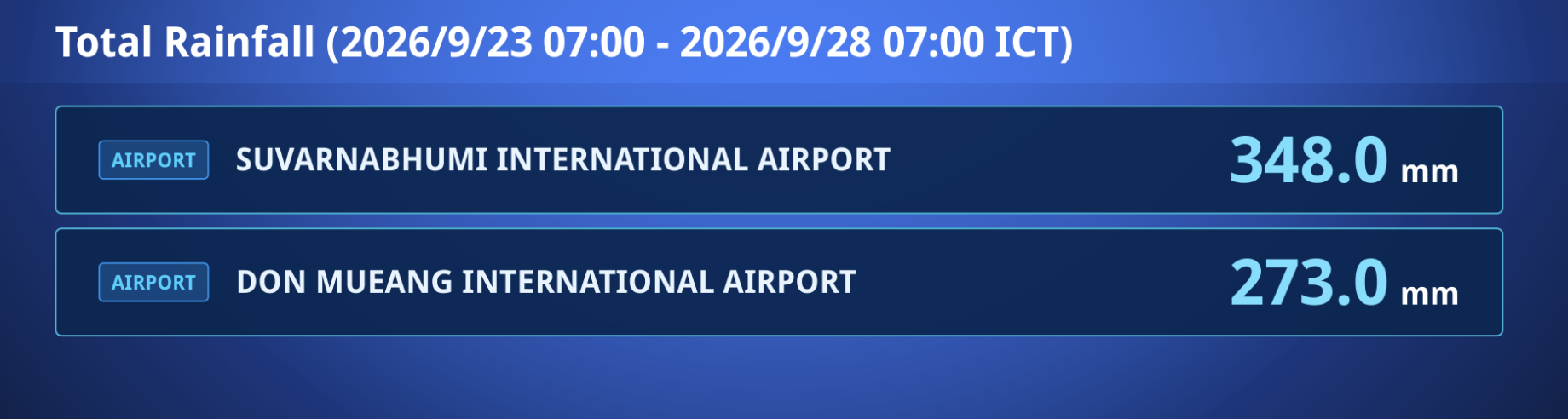
Current impacts and recovery efforts
Thailand’s Ministry of Transport has established an Emergency Flood Response Center to coordinate operations across road, rail, water transport, and aviation around the clock. It has also deployed equipment, including mobile drainage pumps and tow trucks, to flood-affected areas.
The MRT Blue, Purple, Yellow, and Pink lines are operating as usual. Meanwhile, services on some sections of the State Railway of Thailand’s Eastern Line have been adjusted. The Red Line, which provides access to Don Mueang International Airport, was also temporarily suspended but has since resumed operations.
Outlook and implications for airport operations
The low is expected to continue westward, moving across Myanmar toward the Andaman Sea. Another episode of widespread, organized heavy rain around Bangkok is considered unlikely. However, colder air has moved in aloft behind the departing low. Near the surface, conditions remain warm and humid, increasing the temperature difference between the lower and upper atmosphere and making the atmosphere unstable. As a result, locally developing cumulonimbus clouds could bring thunderstorms with rain (TSRA), especially from the afternoon into the evening.
For airport operations, the risk of new flooding from prolonged heavy rain is expected to ease, but thunderstorms could still cause disruption. Lightning near the airports may temporarily halt ground operations, force arriving aircraft to hold, delay departures or require route changes to avoid cumulonimbus clouds.