











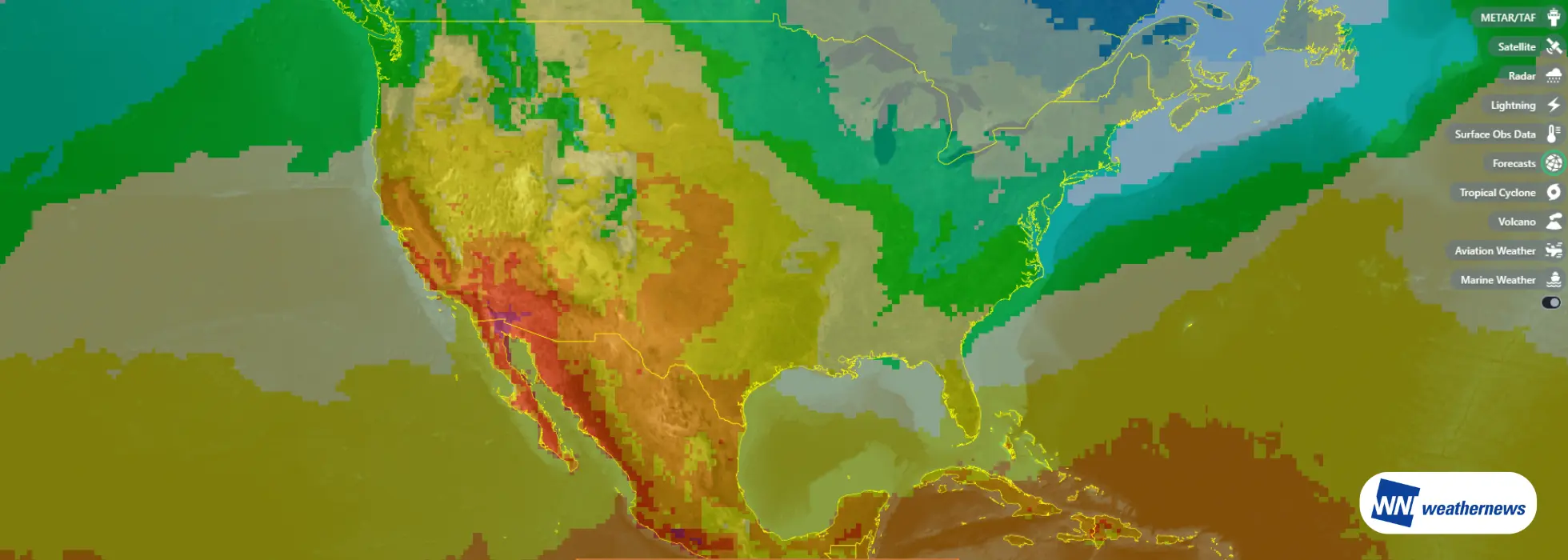
Through around March 22, unseasonably high and potentially record-breaking temperatures are expected to persist across the western and southwestern US. Temperatures are forecast to be 20–30°F above normal, with the potential to break historical March records in many locations. This widespread heatwave is also expected to impact aviation operations. In particular, high temperatures may lead to maximum take-off weight (MTOW) restrictions at major airports.
Meteorological Overview
This record-breaking heat is primarily caused by a pronounced meandering of the upper-level westerlies, resulting in a strong high-pressure ridge over the western and southwestern United States. As a result, in addition to the inflow of warm, summer-like air from the south, the persistence of the high-pressure system is expected to maintain clear skies. Strong solar radiation will continuously heat the surface, potentially leading to unseasonably high temperatures.
In particular, at Los Angeles International Airport, Harry Reid International Airport, and Oakland International Airport, temperatures are forecast to be more than 9°F higher than the highest values recorded in the same month over the past 10 years (2016–2025). Therefore, caution is advised regarding potential impacts on flight operations.
Temperature Forecasts for Major Airports in the Western US (Selected Airports)
| Airport | Los Angeles International Airport | Harry Reid International Airport | Phoenix Sky Harbor International Airport | San Francisco International Airport | Oakland International Airport | Norman Y. Mineta San Jose International Airport | San Diego International Airport | Sacramento International Airport |
|---|---|---|---|---|---|---|---|---|
| City | Los Angeles | Las Vegas | Phoenix | San Francisco | Oakland | San Jose | San Diego | Sacramento |
| ICAO/IATA | KLAX / LAX | KLAS / LAS | KPHX / PHX | KSFO / SFO | KOAK / OAK | KSJC / SJC | KSAN / SAN | KSMF / SMF |
| Mar 18 (Local) Forecast Maximum Temperature (°F) | 91 | 95 | 100 | 82 | 88 | 91 | 90 | 86 |
| Mar 19 (Local) Forecast Maximum Temperature (°F) | 95 | 99 | 104 | 82 | 86 | 91 | 91 | 86 |
| Mar 20 (Local) Forecast Maximum Temperature (°F) | 91 | 100 | 104 | 82 | 79 | 91 | 84 | 86 |
| March Historical Maximum Temperature (2016–2025, °F) | 82 | 91 | 99 | 82 | 79 | 84 | 88 | 86 |
Why does abnormally high surface temperature directly impact aircraft operations?
Relationship between temperature and Maximum Take-off Weight (MTOW)
In general, as ambient temperature increases, air density decreases and take-off thrust becomes weaker. As a result, the allowable take-off weight is reduced. Therefore, lower temperatures provide greater margin for take-off.
On the other hand, when the ambient temperature exceeds 86°F, and the rate of decrease accelerates sharply at approximately 97°F and above. For aircraft types and routes that normally operate close to MTOW, temperature rise is already a significant operational constraint. Under abnormally high temperature conditions, the impact is likely to extend to a wider range of aircraft types and routes.
Main Impacts and Mitigation Measures
- Payload Reduction
Due to the decrease in allowable take-off weight, the following measures may be required.
・Limiting the number of passengers, even if seats are available.
・Reducing cargo weight, even if there is available space in the cargo hold.
Such measures may be necessary on many routes.
- Fuel Load Reduction
The following relationship applies.
Allowable Payload = Max T/O weight - Aircraft Operating Weight - T/O Fuel Weight
Even if the maximum take-off weight decreases, the aircraft operating weight does not change. Therefore, it becomes necessary to reduce either payload (passengers + cargo), fuel, or both.
The main methods to reduce fuel load compared to normal operations are as follows.
①Not carrying excess fuel
※However, this may be difficult to apply under adverse weather conditions.
②Cancelling direct flights and making an en-route stop for refueling
③Operating under a reclearance flight planning method
All of these methods have significant operational impacts, so payload reduction is typically prioritized.
- Changes in Operating Time Windows
From a temperature perspective, this may be an effective measure. However, other constraints may arise, such as airport and airspace operating time restrictions.