












A surge of warm air is moving over Spain, with unseasonably high temperatures expected to persist from April 18 to 23. The Spanish State Meteorological Agency (AEMET) has indicated that, during this period, temperatures in various parts of the country may exceed the April records based on the 1991–2020 climatological baseline. These levels are expected to be comparable to the heat observed in April 2023.
Meteorological Background
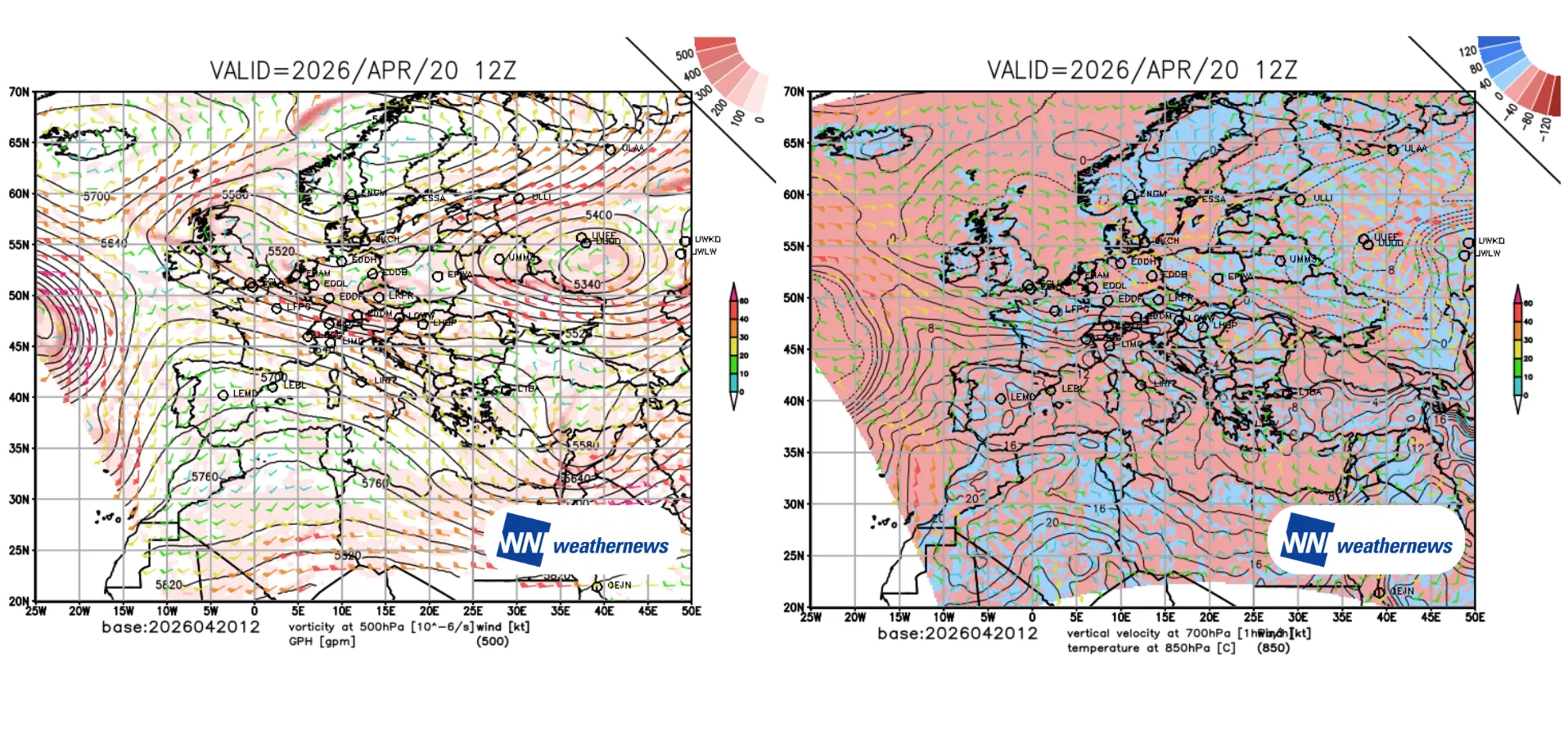
Around 15Z on April 23, the Iberian Peninsula is expected to remain under the influence of a 500 hPa ridge, particularly over its eastern parts. At the surface, the region is likely to be on the rear side of a high-pressure system centered over the Mediterranean. At 850 hPa, warm air with temperatures of 18°C or higher is forecast to cover much of Spain, especially inland areas. Combined with solar heating, this will create conditions favorable for further rises in near-surface temperatures.(The figure below shows WNI's OWN model.)
April Maximum Temperatures over the Past 10 Years at Madrid-Barajas Airport (METAR Observations)
At Madrid-Barajas Airport (LEMD/MAD), the average of the April maximum temperatures over the 10-year period from 2016 to 2025 was 26.5°C.
The highest value was 32°C in 2023, followed by 28°C in 2017, 2018, and 2024, and 27°C in 2022 and 2025.
A warming tendency is evident within this period, with higher maximum temperatures observed in the most recent five years. The average was 25.4°C for 2016–2020, compared to 27.6°C for 2021–2025, representing a difference of more than 2°C.
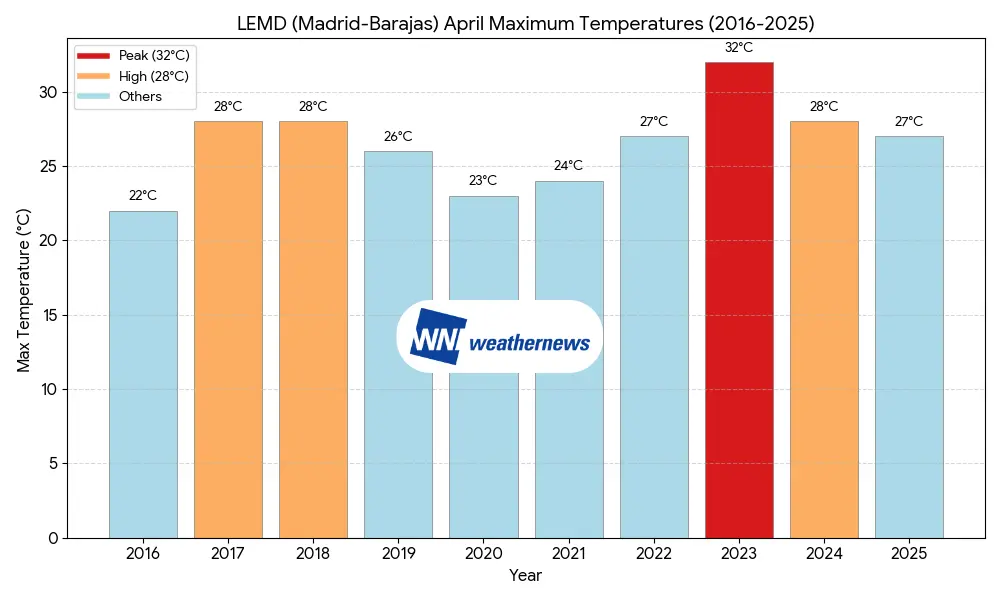
April Maximum Temperatures over the Past 10 Years at Madrid-Barajas Airport (METAR Observations)
Temperature Forecast for Madrid-Barajas Airport
At Madrid-Barajas Airport (LEMD/MAD), the maximum temperature on Monday, April 18 has already reached 28°C, matching the highest April values recorded in 2017, 2018, and 2024.
Temperatures are expected to continue rising, with a chance of exceeding 28°C around April 23. However, it is considered unlikely to surpass the April 2023 record of 32°C, the highest value in the past decade.
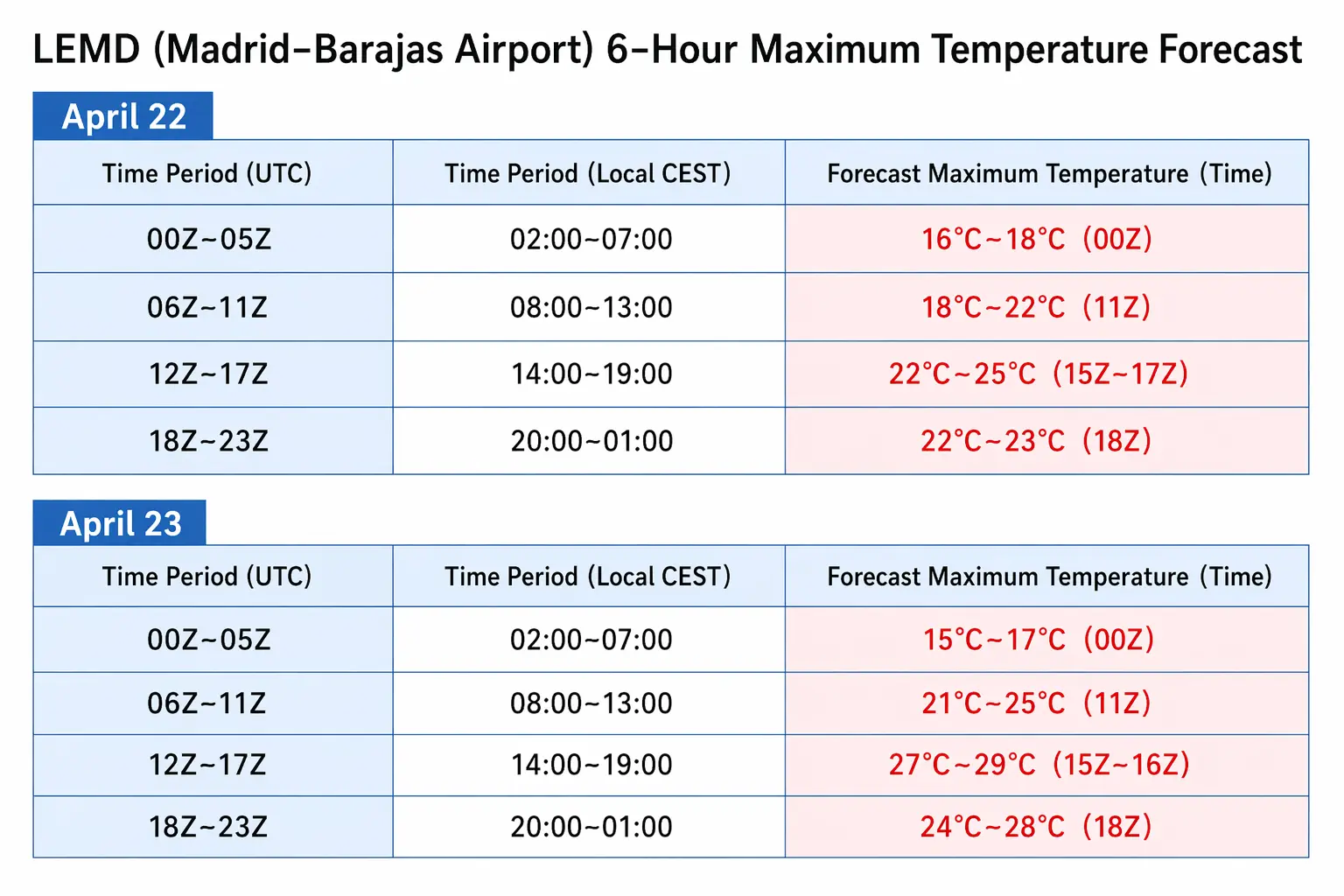
Temperature Forecast for Madrid-Barajas Airport
Why does abnormally high surface temperature directly impact aircraft operations?
Relationship between temperature and Maximum Take-off Weight (MTOW)
In general, as ambient temperature increases, air density decreases and take-off thrust becomes weaker. As a result, the allowable take-off weight is reduced. Therefore, lower temperatures provide greater margin for take-off.
On the other hand, when the ambient temperature exceeds 30℃, and the rate of decrease accelerates sharply at approximately 36℃ and above. For aircraft types and routes that normally operate close to MTOW, temperature rise is already a significant operational constraint. Under abnormally high temperature conditions, the impact is likely to extend to a wider range of aircraft types and routes.