









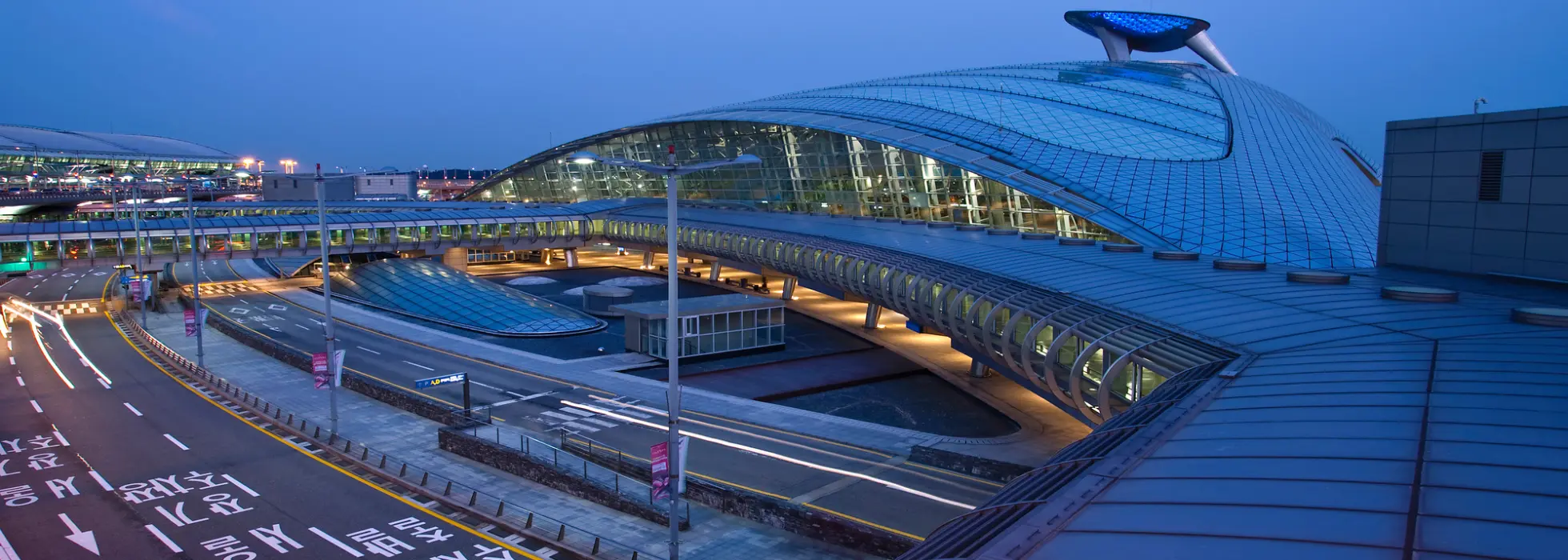
Incheon International Airport in South Korea (RKSI/ICN) lies in a temperate climate zone with clearly defined seasons, and different meteorological risks affect operations throughout the year. Strong northwesterly winds and snowfall in winter, sea fog from spring to summer, and thunderstorms in summer are among the seasonal weather characteristics. Understanding these seasonal weather patterns is essential for developing stable flight operation plans.
Topography and Climate
Incheon International Airport (RKSI) is an international airport located on Yeongjong Island, west of Seoul, South Korea. The airport island is surrounded by the sea, and the large tidal range influences its local weather characteristics. The region has clearly defined seasons: strong northwesterly winds associated with the winter monsoon in winter; sea fog from spring through summer; thunderstorms in summer; and visibility restrictions caused by radiational cooling as well as snowfall from autumn into winter. These seasonal weather phenomena can affect flight operations in different ways throughout the year.
Spring (March–May)
In early spring, strong northwesterly winds associated with the winter pressure pattern can still occur, but they gradually decrease while strong southwesterly winds ahead of passing cold fronts become more frequent. On average, winds exceeding 20 knots occur about once every few days, and attention should also be paid to crosswind components. In addition, sea fog becomes more likely to develop from April onward. In many cases, visibility recovers to more than 1,000 m by around 23–01Z, although it can occasionally persist longer.
Summer (June–August)
This is the peak season for sea fog. In July, visibility falls below 1,000 m about once every three days. The fog often advects into the area with southwesterly or south-southeasterly winds, and a rapid drop in visibility and ceiling after the evening hours requires particular attention. When dense fog covers a wide area, it may persist until around midday, and in some cases can last throughout the day. Frontal fog associated with the monsoon front also needs to be monitored. Thunderstorms also become frequent in July and August, with lightning observed on roughly one day each week. These events are often associated either with the monsoon front or with cold air aloft interacting with warm southerly winds in the lower atmosphere.
Autumn (September–November)
The occurrence of sea fog and thunderstorms gradually decreases, but by around November, visibility restrictions caused by radiational cooling can occur during the early morning and evening hours. Although Incheon Airport is located on an island, the surrounding sea has a large tidal range, and at low tide, radiational fog may advect in from the Seoul area during the night or early morning with easterly winds. By November, northwesterly winds become dominant, and mean wind speeds exceed 20 kt about once every few days.
Winter (December–February)
The occurrence of sea fog and thunderstorms becomes less frequent. However, around November, visibility restrictions caused by radiational cooling can occur in the early morning and evening hours. Although Incheon Airport is located on an island, the surrounding sea has a large tidal range, and at low tide, radiational fog may advect in from the Seoul area during the night or early morning with easterly winds. By November, northwesterly winds become dominant, and mean wind speeds exceed 20 kt about once every few days.