








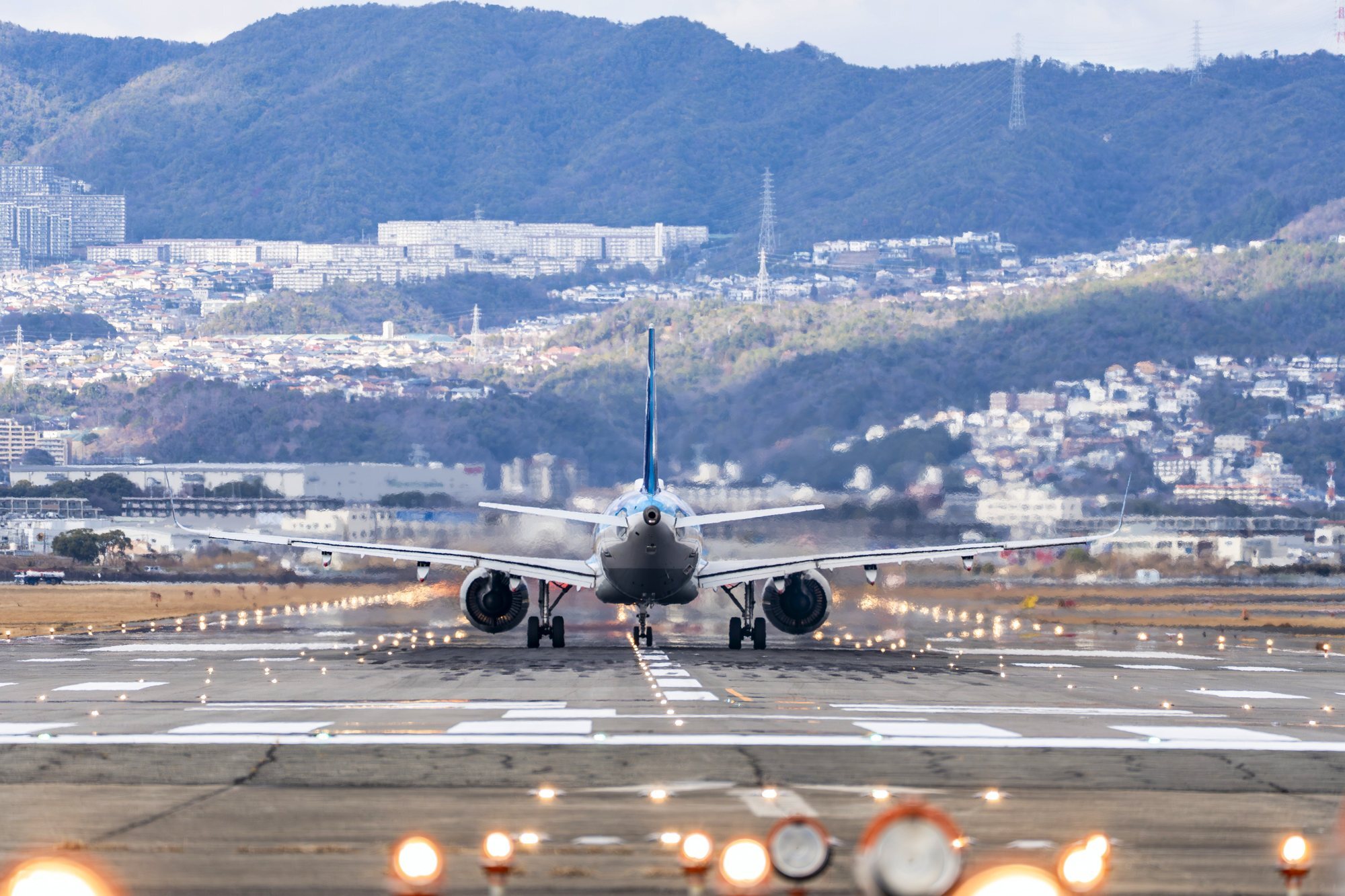
Kansai International Airport (RJBB/KIX) is a major offshore airport located in Osaka Bay and serves as a key international gateway for the Kansai region. Surrounded by complex mountainous terrain, the airport is influenced by multiple local wind regimes that are critical for flight operations. This article summarizes the meteorological characteristics of RJBB, focusing on the relationship between terrain and wind patterns.
Terrain Overview
Kansai International Airport (RJBB/KIX) is located approximately 40km southwest of central Osaka, on an artificial island in Osaka Bay, roughly 4km offshore. Surrounded by mountain ranges and islands on all sides, the airport sits within a uniquely complex meteorological environment.
| Direction | Terrain | Distance from Airport | Representative Peak (Elevation) |
|---|---|---|---|
| North | Rokko Mountains | approx. 40km | Mt. Rokko (3,055ft) |
| Northeast | Ikoma Mountains | approx. 45km | Mt. Ikoma (2,106ft) |
| East | Kongo Mountains | approx. 40km | Mt. Kongo (3,690ft) |
| South | Izumi Range | approx. 15km | Mt. Katsuragi (3,025ft) |
| West | Awaji Island | approx. 30km | Highest point (1,995ft) |
This terrain configuration gives RJBB a hybrid climate — combining both maritime and basin-like meteorological characteristics.
Wind
Three Airflow Corridors into Osaka Bay
The following three topographic gaps act as the primary airflow channels into Osaka Bay, exerting a significantly influence on wind conditions at RJBB:
- Osaka Plain — lowlands along the Yodo River
- Akashi Strait (from the Seto Inland Sea)
- Tomogashima Channel (between Awaji Island and Tomogashima Island)
Airflow through these corridors contributes to lee-side weak wind zones, foehn effects, and atmospheric stagnation over the plain.
Reference Wind Observation Point
Wind values reported in METAR and TAF represent observations taken at the western end of Runway 1 (near the RWY06R touchdown zone).
Three Dominant Wind Directions
Influenced by surrounding terrain, wind at RJBB predominantly falls into three systems, varying by season, time of day, and pressure pattern.
| System | Direction | Inflow Corridor |
|---|---|---|
| ① | Northeast (NE) | Osaka Plain — Yodo River lowlands |
| ② | Southwest (SW) | Tomogashima Channel |
| ③ | Northwest (NW) | Seto Inland Sea → Akashi Strait |
Winds from the southeast (SE) quadrant are rare, as surrounding terrain acts as a natural barrier.
Diurnal Variation (Sea-Land Breeze)
Wind speed exhibits a clear diurnal pattern, generally being weaker during the early morning hours and strengthening from daytime into the afternoon.
Seasonal Variation
Although the seasonal variation in wind speed is not particularly large, winds are generally stronger in winter and weaker in summer.
Based on data from the past five years, winds tend to be stronger during the winter months (December–February), with a higher number of days recording daily maximum wind speeds exceeding 20 kt. In contrast, July is typically the calmest month of the year. However, during summer, tropical cyclones may affect the area, and wind speeds can increase significantly when a storm approaches or passes nearby.